Friday, 20 October 2023

Product-led Growth (PLG)


Product-led growth (PLG) is a strategy in which companies rely on their product to attract and keep customers, rather than focusing heavily on marketing and sales efforts. In a PLG approach, the product is designed to be user-friendly from the start, often allowing people to try it for free or with minimal commitment. Companies also encourage users to invite others to use the product, which can create a chain reaction. They use data and feedback to make the product better over time. As users see value in the product, they might upgrade to paid versions. This approach allows companies to grow efficiently and serve more customers. 

Some key aspects of product-led growth:

  • Self-Service Onboarding: PLG products offer a seamless and user-friendly onboarding process, allowing users to sign up and get started with minimal friction. They provide clear value from the start, and encourage users to explore the product.

  • Freemium: PLG companies tend to offer freemium models or free trials, allowing users to experience the product's core features without an upfront financial commitment. This encourages adoption and helps users understand the product's value.

  • Viral Loops: PLG's often incorporate viral marketing tactics, where users are encouraged to invite others to join the platform. This can be through referral programs, sharing features, or collaboration tools.

  • Data-Driven Iteration: PLG companies rely on data and user feedback to continuously improve the product. They make data-driven decisions to enhance user experience, add features, and address pain points.

  • User-Centric: The focus is on delivering value to the end-users. User feedback and needs guide, but do not drive product development and feature prioritisation.

  • Customer Success and Upselling: Successful PLG companies ensure that users have a great experience and receive ongoing support through in-product messaging, chat support, and helpful documentation. As users understand the value of the product, they are more likely to upgrade to premium or paid plans.

  • Low Touch Sales: In PLG, sales teams have a lower-touch role, as many customers are already familiar with the product by the time they consider purchasing.

  • Scalability: PLG allows companies to scale efficiently, as the product itself plays a significant role in acquiring and retaining users. As more users join, generally the cloud infrastructure is expanded in accordance.
In a product-led growth organisation, the goal is to have an almost human free customer acquisition model, where the product itself makes it as simple as possible for users to use, signup, share, and upgrade to a premium version.

In a Product-led organisation the product is at the core of the offering, the entire organisation revolves around the product and thinks about how they can leverage the product in different ways. The product isn't just part of the overall customer experience, it is central to how every function within the organisation performs their roles.

Six characteristics of product led organisations:

  1. Align each function around the product: instead of the product being the sole responsibility of the product & engineering teams, the product is central to each department, employees are empowered via the product to better engage with the customers.
    • Customer success team: may build in-app onboarding process 
    • Marketing: may leverage in-app message to drive up-sale & cross-sale opportunities 

  2. Make decision with data over gut feel: instead of solely relying on intuition, product-led organisations leverage in-app data to make evidence backed decisions.
    • Leverage data to sunset unused features
    • Leverage data to identify and smooth out friction

  3. Use the product as a marketing channel: leverage in-app messaging to communicate with the user base, segmented and targeted user engagement. 

  4. Amazing onboarding: create a seamless and delightful onboarding experience, their product is simple and intuitive to use. 
    • Onboarding is tailored to each user segment

  5. Empower users: to solve their own problems, they provide readily available, context specific support information, allowing users to quickly resolve their own issues without the need to reach out to customer support.

  6. Collect & user customer feedback: leverage user feedback to drive innovation and product direction, user in-app surveys and polls to collect data to make informed iteration decisions.

Jobs to be done framework

The Jobs to Be Done framework is a concept used to better understand and address the underlying motivations and needs of users. Its focus is on the 'job' the user is aiming to accomplish, rather than the product itself. This job could be a specific task, goal, or problem. Customers 'hire' products or services that they believe will help them get the job done more effectively. There are two types of jobs which users hire products to complete, they are functional and emotional Jobs:
  • Functional jobs: refer to the practical tasks or goals a customer wants to achieve.
  • Emotional jobs: refer to the psychological or social needs associated with the job.
This framework ties directly into the Product-led organisation by focusing on what the user is aiming to achieve, and providing them the tools to do so. The jobs to be done framework breaks jobs down into functional and emotional aspects, then it continues to break the emotional aspects down to personal and social dimensions.

  • Functional: aspects are the basic utility of what the job delivers, the thing that get's accomplished
  • Emotional: aspects are the emotions the user feels as they complete the job
    • Personal: dimensions refer to how the user feels about the job
    • Social: dimensions refer to how users feel other's perceive them about competing the job

Data driven decisions

Whether one refers to it as data driven decisions making, evidence based decisions or just rational, making decisions that are reinforced with data is at the heart of a Product-led organisation. The aim is to eliminate the ambiguity of the 'Gut feeling' and embrace the 'scientific method' to make a hypothesis, test it, and leverage real data to make an informed decision. Some questions the product manager can ask themselves are:
  • How sticky is my product?
  • Is my feature adoption rate what it should be?
  • Are my customers using enough of my product?
  • Am I building what my customers want? or what I think they want?
The answer to these questions can be found in real life analytics of the digital product or service. It may be difficult to choose which data points to collect and investigate, this is why it is a good practice to first decide what you want to know then choose the data that will provide you with the information, rather than looking at all the data and trying to decipher what it means

There are three main categories of KPI's to track inside a product:
Business outcomes Customer retention, key business financial metrics, is it selling?
Product usage How is the product being used by users, which features, and when?
Product quality How well does the product technically work, downtime?

Though there could be 100s of various KPI's a product-led organisation may want to keep track of, here are the top 10 KPI's that for certain any organisation will want to know

  1. Net revenue retention (NRR): how much revenue is my product retaining from existing customers?
  2. Adoption: Are users adopting my product and the key features within it?
  3. Stickiness: do users keep coming back to my product?
  4. Growth: Is my product acquiring and retaining new users faster than existing users are abandoning it?
  5. Product engagement score (PES): how are users engaging with the product overall?
  6. Retention: Are users building enduring habits inside the product?
  7. Time to value: How long does it take for users to find value in my product?
  8. Net promoter score (NPS): are users and customers happy with the product?
  9. Top feature requests: what do users want form my product?
  10. Product performance: from a technical perspective how well does the product operate?

Continuous delivering 

It is now common place for software as a service (SaaS) companies to continuously deliver functionality, rather than having annual or quarterly releases, it is not uncommon for organisations to release small features weekly and gauge adoption. In SaaS models it is not uncommon for customers to maintain monthly subscriptions, this provides organisations with smaller but more steady revenue streams rather than huge cash influxes once every version.

However this creates much more opportunity for customer churn (the loss of customers or subscribers), Product managers must be ever more vigilant of not just overall product value, but also of granular feature value. Each feature a customer is paying for but not using represents a missed opportunity and lowers perceived value of the product. It is important for product managers to either course correct an inactive feature or consider sunsetting them. Each unused feature costs the organisation money, but does not provide value to the customer.

Communication of new features can prove to be a delicate tightrope, continuous delivery models provide feature updates on a daily or even hourly basis, though these could be summed up in one weekly or monthly or quarterly communication. An effective alternative to indirect communication from out of product channels would be to bring feature communications inside the product; to create informative nudges, educating users by segment of new or upgraded features.

Some considerations to make when forming feature communications:

Consideration #1
Relevance: tailor your communication to the appropriate users
Consideration #2
Desired action: align your announcement to the desired action

Designing a launch plan that accelerates adoption

  1. Determine what a successful launch looks like
  2. Determine how you will communicate the launch
  3. how will you engage customers around the launch
Once a feature is launched there are 3 dimensions to track to gauge how successful of a feature/launch it was:
  1. Breadth of adoption: how widely has the feature been adopted by the targeted segment(s)
  2. Time to adopt: how long does it take users to begin using a feature.
  3. Duration of adoption: how long do users continue to engage with the new feature.
Finally ensure that you provide a mechanism to collect qualitative feedback from users regarding new features. A proactive method to bring user qualitative feedback into future iterations is to listen to the customers voice from your current offerings in order to learn from what you are doing right as well as wrong from the customers perspective. Customer feedback should inform your roadmap, not drive it. An excellent way to validate the importance of feedback is to create a "Product feedback policy", in essence a document which explains how to submit feedback, how often it's reviewed, and how updates are communicated back. This policy signals to internal teams the value of customer feedback, while signalling to customers that their opinions and voices matter to the organisation.

Follow these steps to create a feedback policy:
  1. Signal the value of feedback, internally as well as externally
  2. Define how can can customers provide their feedback
  3. Create a transparent review process
  4. Communicate back to customers
  5. Get your teams on board

Product operations

Product operations partners and works with the Product, Engineering and Customer success teams in order to:
  • Tighten product feedback loops: collect, validate and leverage customer feedback.
  • Systematise product development and launches: Leverage defined processes with data driven decision making to create predictable and controlled feature development cycles
  • Scale product knowledge across the organisation: encourage cross functional teams, and holistic ownership of the product.

Prod ops focuses on:
  • Wrangling data in support of better product decisions
  • Managing release schedules and go-to-market readiness
  • Coordinating internal and external launches and communications
  • Orchestrating the right messages and experiences inside the product

In-app Onboarding

Is the process of helping new users become proficient in your product by leveraging the product itself as an introductory enablement channel, converting a freemium user to a paying customer. Guiding the user to the value they are looking for (the aha moment), drastically increases the chance of that user returning/upgrading to a premium account. There are numerous methods to help users find their way within an application:

Walkthroughs: are guided in-app dialogues which 'walk' users through all the features which they can utilise, the key is to design these onboarding walkthroughs with the following in mind:
  • Sell the value of the feature: convince the user it's worth their valuable time
  • Link features together: demonstrate to users the synergetic value of the product as a whole
  • Help users "learn by doing": inviting users to take actions along the way of the walkthrough 
Tooltips: provide in app points of interest or information, letting user's know of specific granular functionality. These are the most common and often times most valuable to all users, they can provide information of new features or act as a reminder of existing features.

Modals: break the user's flow and should only be used sparingly to inform of the user absolute must know information.

Landing pad: these can be thought of as full screen modal, and should only be used appropriately, generally to nudge the user into one of several options, in situations where they should or must choose.

Blank slates: are referred to as pages in which user creates content, these can prove to be intimidating to users and should be managed via tooltips or some other onboarding mechanism.

Knowledge base: a repository of anything a user may want to know about the product, this information can be disseminated via a dedicated knowledge base, tooltips, modals, etc.

Email: the most appropriate out-of app modality to engage with customers, especially before or after usage.

Products must sell themselves

Consumers in today's market are less tolerant of being told why a product or service is great, and have an expectation of being shown.  Customers no longer respond to flashy advertisements, but want to experience a product before the pay for it. They want absolute assurance, that what they are paying for is worth their time and money. In product-led organisations; marketing partners closely with the product as well as sales departments to provide customers with the opportunity to experiment with most, if not all of the product's features, however with some incentive to upgrade to a premium account. This is known as the 'freemium' model, in essence the customer can try before they buy.

Leveraging in-app messaging, customer health and sentiment data, the sales department can identify leads and directly target them through the application as well as other channels, in essence letting the product sell itself, by identifying freemium users who are good candidates for up-selling or cross-selling. It is the difference between marketing qualified leads vs product-qualified leads.

Marketing-qualified lead (MQL)
Leads which the marketing team deems adequately qualified for the sales cycle
Product-qualified leads (PQL) 
Users who are not yet paying customers but have gained value from the product

MQLs are are leads who could potentially find value with the product, whereas PQLs have already experienced some value from the product; PQLs are far more likely to be upsold to premium accounts, due to the fact that they are already familiar with the product and have first hand knowledge of some of its value. This greatly product experience greatly simplifies the sales team's job to sell the PQL on the remaining value proposition. Finally because PQLs are already familiar with the product, they are a much sounder investment, from a sales as well as support perspective.

Best practices for freemium strategies:

  1. Set usage limits and set expectations up front (don't give too much away for free)
  2. Monitor heavy usage to target your upsell (target users who frequently use your product)
  3. Create valuable premium features (ensure that user's are aware of the premium features)
  4. Show results (inform users of added premium value)

Leverage in-app data to gain social proof

Using in-app metrics can help an organisation identify users who are poised to provide high value social proof in the form of: reviews or/and customer testimonials. Once these users are identified the product can solicit these reviews or testimonials through modals or some other in-app mechanism.

The cost of new customers is high

This is why it is extremely important to retain existing customers, by leveraging in-app data you can identify customer at risk of churn and deploy mitigation measures in order to retain them.

  • In-app metrics can identify which usage pattern lead to account growth and renewals: this will allow your design team to create experiences that nudge users toward thees positive usage patterns, in which not only do customers maximise their value, but also stay with the product.
  • Measuring retention over time see if onboarding is yielding temporary changes in user behaviour or habits that stick: by identifying if your product becomes a consistent part of your users day or week you can accurately predict if you will retain or lose that customer. 
  • At a more granular level, you can leverage in-app metrics to identify which features are being heavily used, and which are not: this will inform you which features are sticky vs one's which your users may not be gaining any value from. 

From your metrics you can create a customer health score and segment customers into three groups: 

  • Unhealthy: customer which may already be lost, the cost of retaining them may not be worth it
  • Healthy: customers who are the best candidates for cross-selling
  • Neutral: customers with the potential to not only become advocates, but move into healthy status.
Establishing this "health score" is no easy feat, it takes a lot of analysis and understanding of unique data points and weighing those points to best represent the customers health score. Once you have established these "health scores" you can:
  • Use data to better inform interactions with customers.
  • Automate in-app interactions: nudge low-usage customers to high value features.
  • Land & expand: help existing users do more inside the product.
To create a customer health score:
  1. Star by capturing every metric that may provide insight into a customer's health score
  2. Group those metrics into categories that make sense, these categories may be deduced from the actual metrics you identify, however some potential groupings could be:
    • Product adoption
    • Sentiment
    • Support experience
    • Purchasing behaviour
  3. Prioritise the features by time frame 
    • Choose 3 to 4 features that you could incorporate into your score in the short term.
    • Repeat for medium and long term features, create a roadmap of product features and how the metrics inform a customers health score.
  4. Associate metric groupings to features and provide weights
    • Product adoption (30%)
    • Sentiment (10%)
    • support experience (20%)
    • Purchasing behaviour (40%)
  5. Create an action plan for customer health status:
    • Healthy customer: Ask them to speak at an even or provide a referral
    • Neutral customer: Nudge them to more value-added features, try to convert them based on what health grouping is holding them back.
    • Unhealthy customer: Offer a coaching session or target them with content to help them gain more value from your product or service.

Tuesday, 17 October 2023

Product management lifecycle

The product management lifecycle is how product managers conceptualise, build, launch and iterate on software products. It is a tried and tested high level framework for how great products are built or improved, it can viewed as a map to help guide product teams to a successful, value added product.

Define a business objective

The product management lifecycle begins with defining a clear business objective: Defining a business outcome from the onset anchors the product, the team, the stakeholders to a particular value added target; it allows the product manager to ask the question "does this benefit our objective?" if the answer is no, then it's not needed.

Some potential business objective could be:
  • Increase retention: what features & functions will provide value to users
  • Reduce costs: improve UX to decrease the burden on the companies support team.
  • Gain market share: Improve existing functionality or create new industry leading capabilities.
  • Digital transformation: transition a legacy paper system to a digital one, reduce user error, etc

Discover phase

During the discovery phase, the aim is to uncover the pain points of both your customers and the larger market; this phase is all about understanding the problems and challenges faced by your users and potential users, what do they want and need, what is stopping them. Here you can begin to identify potential solutions, however you will not settle on one until the validation phase. It is common to leverage the double diamond design thinking approach for the discovery phase.


The discovery phase is as much art as it is science, this is where the bulk of the solution forming is done. During this phase research is preformed, interviews are conducted, experiments are preformed. It is here that one or more potential solutions are designed. During the discovery phase there are three main research aspects, focused discovery (what the product is suppose to do), data-driven discover (what the evidence says people are doing); UX research: (what people think, say and actually do).  
  • Focused discover: Be as focused as possible during discovery, specifically on the issues that are preventing the business outcome. 
    • Why does the business want this feature/product?
    • What is the goal the features/product aims accomplish?
    • Is the solution the right way to solve the problem?
    • What customer feedback has already been received?
    • What job (jobs framework) is the customer trying to get done?
    • What customer personas/segments are we targeting?
    • What problems do users encounter in the product?
    • Are users doing what we expect in the product? if not, why?
    • What do power users do differently?
  • Data-driven discovery: Leverage the knowledge internal teams posses, Product data usage, and direct customer feedback
    • What does the workflow of our core users look like?
    • What do our successfully retained users do in the product?
    • Where do users we don't retain drop out of the product?
    • What are customers actually trying to accomplish?
    • What features do retained customers engage with the most?
    • Do you see usage patters in the rest of your user base?
    • Where did users who churned drop out of workflows?
  • User research: Also referred to as exploratory research, product managers usually conduct this during the discovery phase to get the lay of the land and gain a contextual understanding of their users.
    • User interviews: 1on1 interviews where you can ask open ended questions.
    • User surveys: collect input from a large group at once
    • Card sorting: shows how users categorise and organise information
    • Observation: watching user's interact with the product or service.

Validation phase

During the validation phase the objective is to choose the right solution(s) to move forward with, this is accomplished by collecting data and leveraging it to make an informed decision. The knowledge gained from discovery phase feeds directly into the validation phase, here you can validate one of your preliminary solutions, or come up with a completely new one. The import thing is to make an informed decision as to which solution(s) to pursue. One of the most important answers that you will find during the validation phase, is the why we are pursuing one solution over another. Some questions you may ask yourself are:
  • What outcomes are resonating most with customers?
  • How can we best solve for our customers' pain?
  • What don't we know about customers' workflows that may help in building the solution?
  • How do we curate a diverse set of customers for interviews? 
  • What pain is so deep that customers would pay for a solution?
The validation phase provides the product manager with the needed information to:
  • Priorities which solutions to build
  • Manage stakeholders better, by reinforcing decisions with evidence
  • Invest in the most value added resources and features

Experimentation & Testing

During the Validation phase, once a solution is selected, the project manager should run some experiments in order to test their decisions: 

Evaluative testing: (if you do not have an existing product)
  • Prototype testing: Upfront testing executed before building anything
  • Fake door test: inviting customers to use a feature that isn't created/released yet to see gauge level of interest
  • Man behind the curtain testing: An orchestrated solution that does not actually exists, (an agent posing as a chatbot)
Live experimentation: (if you have an existing product)
  • Putting things into the product to see how they work
  • Making functionality available tow a small subset of your user base before going into a deeper build
  • A/B testing: putting out two versions of a feature and seeing which performs better. 

There are three main rules to experimentation:
  1. Choose the right experiment, decide what you want to learn, then leverage the appropriate experiment to gain those insights
  2. Choose your audience, ensure that the user's taking part in your experiment have an interest in what you are building.
  3. Use the data you've gained to make an informed and justifiable decision, whether to pivot or not

Build phase

During the build phase, the product manager must partner with engineers and product designers to ensure that the validated solution comes to life as intended; think of these three as the holy trinity of product development, only when the product manger can work openly and cohesively with the design and engineering teams, can the solution reach its full potential.


up to this point the defined solution is an idea, a theoretical solution to a problem. Now it's the product managers job to ensure that the implemented solution correctly aligns to the defined solution; keep in mind that feasibility may become an issue, your solution may have technical constraints and my require a pivot. This is why a close relationship with both the designers and engineers is essential. During this phase you will share and rationalise your product roadmap.

There are three main delivery models which Product designers must be familiar with with:
  • Waterfall: generally the waterfall model has five main stages: Analysis, design, development, testing, support. In this model the product moves through each phase once, this model relies heavily on analysis and design as well as accurate estimation.
  • Agile: a more common iterative approach in which teams work in sprints, time boxed iterations in which the team commits to a particular set of user stories to deliver, which are then validated at the end of each sprint. Between sprints the product owner decides whether to continue or not.
  • Continuous: a modern approach in which multiple features can be worked on simultaneously and as a feature is completed it is tested then released, sometimes multiple times a day.
The main responsibility of a product manager is to create and enforce the Product requirements document or PRD. This document captures and communicates:
  • Key project information: stakeholders, key personal, timeline, current state
  • The objective: The overall aim of the product, the value proposition for the stakeholders as well as the value propositions for the users. It clarifies the problem(s) we are aiming to solve.
  • Assumptions: include any assumptions which had to be made (technical, business or user), and why they could not have been validated through experimentation or data.
  • User stories: include any key information from discovery or interviews from users/stakeholders
  • Designs: Any prototype testing that was conducted, High fidelity screens, visual assets which describe the proposed solution.

Launch phase

During the launch phase the Product manager must create a launch plan to make ensure that customers adopt and continue using new functionality. Here the product manager must work closely with Marketing, Sales and Customer success teams to build a go to market plan that is scaled to the size and importance of the release. Some questions to consider for the launch phase
  • How to ensure that users know about the new feature or product
  • How to foster internal readiness within the organisation
  • How to educate users about the value of the new feature or product
  • How to encourage adoption of the new feature or product
When launching a release there are three main considerations the product manager must take into account.


The three main considerations when coming up with a launch plan are:
  1. What is the size of the release? is it a new product that requires a full PR campaign or is it a small feature release that can be communicate in product.
  2. Who is the target audience, is it the entire user base or a segment or multiple segments. what are the characteristics of the target audience.
  3. What is the desired action, what is the goal of the launch campaign, is to inform users, to encourage a particular action. Be sure to indicate a clear call to action.

Incremental launch tactics

Now a days, digital products are rarely released, but more often are trickled out, small MVPs are released sometimes to a wide audience, and sometimes to a small subset of users, here are a few incremental launch tactics 


Evaluation phase

During the evaluation phase the product manger leverage quantitative as well as qualitative data to evaluate the success of a launch, and use the insights gained for future lifecycles. Quantitative data tells you what happened whereas qualitative data provides the context as to why it happened, both are important to learn from and improve future product management cycles.

Quantitative metrics to evaluate a feature launch


Three useful analytics tools to support the above quantitative metrics are:
  • Paths: help you discover what users are doing before or after using a specific page or feature.
  • Funnels: the measurement of how users move through a defined series of steps
  • Session replay: Enables you to record and visually replay a user's session in the product.
Qualitative metrics to evaluate a new product or feature


Three useful channels to observe in order to support the above qualitative data are:
  • Customer support channels: Identify common themes and recurring problems
  • Social media: monitor for users' feedback and opinions
  • Customer sentiment: Examine Net promoter Score (NPS) before and after a launch

Iteration phase

During the Iteration phase the product  manager reflects on what was built and how it can be improved, and append/updates the product roadmap accordingly:
  • How can we improve the product experience?
  • Do we need to tweak our goals or focus?
  • Should we double down on what's really working?
  • Are R&D teams working on the right projects?
  • Is this moving us closer to our business goal?

Monday, 16 October 2023

Product management

Before we dive into product management, let's first discuss the difference between Project and Product mangers. Product managers are responsible for the overall product strategy and its long-term success, whereas project managers are responsible for the successful execution of specific projects. 

In essence product managers focus on the big picture of a particular product or service, whereas project managers focus on the details of project execution, they are more concerned about budget, time and resources. Project managers are connected to phases of product development, keeping them on time and on budget, whereas Product managers are connected to the lifespan of the product itself. A product will most likely see multiple project managers, whereas it will ideally only have one product manager for it's life cycle.

As you can see if a product has multiple phases; each phase can have a different project manager, however each product or service should have only one Product manger.

Product management is an ever evolving field, it started as a feature factory model, which was more of a reactive approach to product development; it has now evolved into a outcome driven mode.

Feature factory model
  • Can't measure the impact of their work
  • Have frequent failures
  • See poor product and Feature adoption
  • Lack strategic focus
  • Have unhappy customers
Outcomes driven model
  • Can articulate how their work impacts the business
  • Have fewer failures
  • See strong adoption
  • Clear focus and an exiting vision
  • Have happy customers
We've gone from reacting to feature requests to planning and foreseeing them, product management is no longer about designing a feature upgrade, but having a planned roadmap of features, which are designed before they are requested.

The product manager's responsibilities

  1. Setting the products mission and vision (product strategy)
  2. Aligning stakeholders around the product vision
  3. Shipping great software that delights users
  4. Understanding customers and their problems
  5. Understanding the business goals and define what success looks like
  6. Prioritising the backlog of features
  7. keeping up with industry trends and competitors
Theses are broad and non exhaustive responsibilities; the role of the product manager is to live and breath the product; to understand what the business value is to the stakeholders is, as well as what is the value proposition to the users is, and how those two support each other. 

Depending on the organisation there can be multiple types of different product managers, each specialising in a specific domain.


Product managers have 5 high level capabilities that drive their success:
  1. Businessmen: they understand the value proposition of the product, they understand how the product will benefit the organisation's financials.
  2. Leaders: the can inspire and communicate to their teams as well as stakeholders, they can rally developers, designers, data scientist, etc behind one common vision.
  3. Scientific: they make evidence based, data driven decisions, they don't make gut decisions or guesses as to what customers want or need.
  4. Goal oriented: focus on outcomes, tie features to business value
  5. Responsible: they do not allow technical or design debt to accumulate, they balance trajectory with maintenance.

Friday, 26 May 2023

Business model process

"Business Model Generation" is a book by Alexander Osterwalder and Yves Pigneur which introduces the Business Model Canvas, a visual tool for creating and analysing business models.

The book is divided into five parts:

  1. Canvas: section introduces the Business Model Canvas and explains how to use it to design, test, and iterate on business models.
  2. Patterns:  section describes business models with similar characteristics, similar arrangements of business model building blocks or similar behaviours. Theses similarities are referred to as Business model patterns.
  3. Design: section delves into various design techniques which one can use to better create a value added business model
  4. Strategy: section deals with reinterpreting business strategy through the lens of the business model canvas, it helps constructively question established business practices while examining the environment in search of new opportunities.
  5. Processes: section proposes a generic business model design process, which is adaptable to to an organisations specific needs.

Overall, "Business Model Generation" is a practical guide for entrepreneurs, innovators, and business leaders who want to design and optimise their business models to create value for customers and achieve sustainable growth. 

Process

Creating a business model may seem like a daunting task, modelling an existing business may seem more approachable however there are actually four broad instances when creating a business model is appropriate:
  • Satisfaction: the aim of satisfying an existing but unanswered market need.
  • Newness: to bring new technologies, products or service to market that do not yet exist.
  • Disrupting: leveraging a better business model to disrupt the market.
  • Creation: to create an entirely new market that did not exist before.
regardless of which of the overarching four goals of creating a business model you are pursuing there are five key phases to developing a business model:


  • Mobilise: This stage involves building a team, clarifying goals, and establishing a shared understanding of the business model design process. during this phase we set the stage for designing our new business model.
    • Establish project legitimacy by involving respected and visible member of upper management, respected by all in the organisation
    • Manage vested interests by identifying those who will benefit from a business model change, there will be parts of the organisation that will be threatened by change
    • Cross-functional team, ensure that various organisational perspectives are involved in the business model design, the greater the breadth of perspective the better.
    • Orientating decision makers, ensure that they are aware from at least practical perspective how the proposed changes will benefit the organisation as a whole.

  • Understand: In this stage, the focus is on gaining a deep understanding of the customers, market, industry, and competitive landscape. This involves conducting research, gathering data, and analysing insights to inform the design process. Be wary of analysis paralysis, keep the team focused and leverage a hypothesis based approach rather than strictly focusing on data-analysis driven approach.
    • Modelling existing business models, leveraging organisational experts to understand the as-is business model, this will provide an understanding of the existing strengths vs weakness and serve as inspiration for the and improved version/model
    • Look beyond the status quo, it is very difficult to look beyond we've always done it that way, leverage cross functional nature of your team to gain fresh perspectives.
    • Search past the current client base, identifying an untapped market segment is often far more valuable then expanding an existing one by 10%
    • Demonstrate progress, excessive analysis runs the risk of losing management support due to a lack of perceived progress, be sure to share insights and knowledge gained.

  • Design: This stage involves using the Business Model Canvas framework to design the key components of the business model, including customer segments, value proposition, channels, revenue streams, key resources, key activities, key partnerships, customer relationships, and cost structure.
    • Defend bold ideas, in established organisations often times ideas are watered down to ease implementation, this is a delicate balance, defending a bold idea while simultaneously ensuring it's feasibility.
    • Co-design, By involving a diverse breadth of organisation representation on the design team, the team can anticipate and circumvent potential implementation roadblocks.
    • Integration, one of the most important decisions is to whether integrate new business models or to establish new ones, 
    • Long term focus, when inviting new ideas focus your efforts on long term goals, not on quick quarterly increases we are looking to change the way business is done and look for 100% increases not annual 4% ones.

  • Implement: Once the business model has been validated and refined, this stage focuses on implementing the model and executing the necessary actions to bring it to life. 
    • Proactively manage roadblocks, before the implementation phase of the business model, by leveraging a cross-functional team in previous phases most implementation roadblocks should have been identified and mitigated, before the implementation phase.
    • Project sponsorship, an important success element is to maintain visible support from a respected senior manager, this sponsorship will legitimatise your endeavours. 
    • Old vs New business model, figuring out whether to integrate the new model into an existing one or to create it's own separate model, integrate into an existing business unit or to spin off a new one? creating the right structure is essential for success.
    • Communication Campaign, to counter 'fear of the new' a multi channel internal campaign announcing the new business model and creating excitement as well as interest is essential to gain mass buy in from the organisation.

  • Manage: Adapt and modify the business model in response to market reaction, Continues monitoring and updating the business model to changing market forces:
    • Governance, establishing a cross functional governance group, whose responsibility is to track and manage business models across the organisation, with the aim of ensuring that each model is up to date with current market forces.
    • Synergies & Conflicts, one of the responsibilities of the business model governance group would be to manage any synergies between models as well as mitigate and conflicts which could arise.
    • Portfolio, document and maintain a portfolio of all the organisations business models and the impact/influence they have on each other.
    • Beginner's mindset, do not fall into it's always worked this way mindset, regularly take a fresh look at each model, challenge everything. Market forces move suddenly and you may need an overhaul sooner than you think.


Business model strategy

"Business Model Generation" is a book by Alexander Osterwalder and Yves Pigneur which introduces the Business Model Canvas, a visual tool for creating and analysing business models.

The book is divided into five parts:

  1. Canvas: section introduces the Business Model Canvas and explains how to use it to design, test, and iterate on business models.
  2. Patterns:  section describes business models with similar characteristics, similar arrangements of business model building blocks or similar behaviours. Theses similarities are referred to as Business model patterns.
  3. Design: section delves into various design techniques which one can use to better create a value added business model
  4. Strategy: section deals with reinterpreting business strategy through the lens of the business model canvas, it helps constructively question established business practices while examining the environment in search of new opportunities.
  5. Processes: section proposes a generic business model design process, which is adaptable to to an organisations specific needs.

Overall, "Business Model Generation" is a practical guide for entrepreneurs, innovators, and business leaders who want to design and optimise their business models to create value for customers and achieve sustainable growth. 

Strategy

In todays day and age, the old proverb "If it's not broken, don't fix it" no longer applies, we very much live in an era of rapid change, to survive in the business world we must embrace that change and evolve with it or be left behind. The environment from a technological, competitive, customer, socio-econimcal and so on perspective is rapidly changing and your business cannot afford to fall behind, this is why it is more imperative than ever to constantly challenge and reassess one's business models and opportunities. 

there are four main areas of the environment which impact your business:
  • Market forces:
    • Market segments: the major customer groupings for your product or service, describe their attractiveness, seek to identify new segments.
    • Needs & demands: Outline what the market needs and analyses how well they are served.
    • Market issues: Identify key issues driving and transforming your market form the customer and offer perspectives.
    • Switching costs: Describes elements related to customers switching business to a competitor.
    • Revenue attractiveness: Identify elements related to revenue attractiveness.

  • Industry forces:
    • Suppliers & other value chain actors: Describe the key value chain incumbents in your market and spots new players entering the market, ensure that you are not depended on one particular supplier.
    • Stakeholders: Specify which actors may influence your organisation and business model.
    • Competitors (incumbents): Identify competitors and their relative strengths.
    • New Entrants (insurgents): Identify new insurgents into the market and determine whether they compete with a business model different than yours.
    • Substitute products & services: Describe potential substitutes for your offers, including those from other markets and industries. 

  • Key trends:
    • Technology trends: Identify technology trends that could threaten your business model or enable it to evolve or improve
    • Regulatory trends: describe regulations and laws that influence your business model
    • Societal & cultural trends: Identify major societal trends that may influence your business model
    • Socioeconomic trends: Outlines major socioeconomic trends relevant to your business model, Socioeconomic trends provide valuable insights into how the market and consumer preferences are evolving.

  • Macroeconomic forces
    • Global Market conditions: Outline current overall conditions from a broader macroeconomic perspective factoring the impact of overall performance of an economy.
    • Capital markets: the financial systems and platforms where you raise capital by issuing and trading various types of securities. Understand the current resources required for your business model
    • Economic Infrastructure: the physical and organisational structures, facilities, and systems that support economic activities and enable businesses to operate effectively. It encompasses various components that provide the foundation for economic development, such as transportation networks, communication systems, energy supply, and financial institutions. 
    • Commodities & other resources: Highlight current prices and price trends for resources required for your business model.

Evaluating your business model

Just like an annual medical checkup, your business model(s) will benefit from an annual review, by preemptively reviewing your business models you can react to, or take advantage of environmental forces before they impact you or you miss an opportunity.

There are two approaches to evaluating your business models, to evaluate each individual building block and of course reviewing the business model as a whole, it is important to understand that these activities are complementary.

One of the most common assessment tools is to use the SWOT analysis tool, 


This is a simple tool that is commonly known throughout the business world, however this tool has a tendency of producing vague insights that are difficult to action, when conducting a SWOT analysis, keep in mind the environmental factors and how they may impact your business model.

Strengths vs weaknesses 

Strengths are the internal characteristics and resources that give a business a competitive advantage over others. These are factors within the control of the business and represent its positive attributes. Whereas weaknesses are the internal factors that hinder a business's performance and place it at a disadvantage compared to competitors. These are areas where the business needs improvement or lacks certain capabilities. Strengths and weakness can often be thought of opposite sides of the same coin, generally the opposite of your strengths are your weaknesses, review some of the following questions to get an idea of both strengths and weaknesses around the individual building blocks of your business model.

Strength vs weakness value proposition assessment
  • Are our value propositions are well aligned with customer needs?
  • Do our value propositions have strong Network effects?
  • Do strong synergies between our products and services exist?
  • Are our customers satisfied with our products and/or services?

Strengths vs weakness of Cost/Revenue assessment
  • Do we benefit from strong margins?
  • Is our revenue are predictable?
  • Do we have recurring revenue streams and frequent repeat customers?
  • Are our revenue streams diversified?
  • Are our revenue streams sustainable?
  • Do we collect revenues before we incur expenses?
  • Do we charge what customers are willing to pay for?
  • Our pricing modes capture full willingness to pay?
  • Do we benefit from economies of scale?

Strengths vs weakness of Infrastructure Assessment
  • Are our key resources difficult or simple for competitors to replicate?
  • Are our resource needs predictable?
  • We have access to resources as we need them?
  • Do we have to maintain high volumes of stock?
  • We efficiently execute key activities?
  • Are our key activities are difficult to imitate?
  • Our production quality is high and consistent?
  • Do we balance in-house with external execution?
  • Are we are focused and work with partners when necessary?
  • Do we have strong relationships with our key partners?

Strengths vs weakness of Customer Interface Assessment
  • Are our customer churn rates low?
  • Is our customer base is well segmented?
  • Are we continuously acquiring new customers?
  • Are our Channels are efficient?
  • Are our channels effective?
  • Channel reach is strong among our customers?
  • Can customers easily see our channels?
  • Channels are strongly integrated?
  • Do our channels provide economies of scale?
  • Are our channels aligned to our customer segments?
  • Do we have strong customer relationships?
  • Is relationship quality aligned with customer segments?
  • Do relationships bind customers through high switching costs?
  • Is our brand strong and recognisable?

Threats

Threats are external factors that pose risks or challenges to a business's performance and profitability. These factors are outside the control of the business but can have a significant impact on its operations. Threats may include intense competition, economic downturns, changing consumer preferences, disruptive technologies, regulatory changes, or supplier-related risks. By identifying potential threats, businesses can proactively develop strategies to mitigate risks, adapt to changing conditions, and stay resilient in the face of challenges.

Threats to value proposition assessment
  • Are substitute products and services available?
  • Are competitor threatening to or offering similar products/service at lower rates?
Threats to Cost/Revenue assessment
  • Are our profit margins threatened by competitors or technology?
  • Is a disproportional amount of our revenue coming in from a minority of streams?
  • Are any revenue streams at risk of disappearing or decreasing in flow?
  • Which costs are unpredictable and my increase?
  • Which costs threaten to outpace the revenue they support?
Threats to Infrastructure 
  • Could we face a disruption in the supply of certain resources?
  • Is the quality of our resources threatened in any way?
  • What key activities might be disrupted?
  • Is the quality of our activities threatened in anyway?
  • Are we in danger of losing any partners?
  • Might our partners collaborate with our competition?
  • Are we too dependent on any particular partner or supplier?

Threats to our Customer interface
  • Could our market become saturated soon?
  • Are competitors threatening our market share?
  • How likely are customers to defect to a competitor?
  • How quickly will competition intensify in our market?
  • Do any competitors threaten our channels?
  • Are any of our channels at risk of becoming irrelevant to our customers? 
  • Are any of our customer relationships in danger of deteriorating?

Opportunities

Opportunities are external factors in the business environment that have the potential to contribute positively to a company's growth and success. These factors arise from changes in the market, industry trends, technological advancements, emerging consumer needs, or regulatory shifts. Opportunities could include expanding into new markets, introducing innovative products or services, leveraging partnerships or collaborations, or capitalising on favorable market conditions. Identifying and seizing opportunities can enable businesses to enhance their market position and achieve sustainable growth.

Value proposition Opportunities
  • Could we generate recurring revenues by converting products into services?
  • Could we better integrate our products ore services?
  • Which additional customer needs could we satisfy?
  • What compliments to or extensions of our Value proposition are possible?
  • What other value could we provide to our customers?

Cost/Revenue Opportunities
  • Can we replace on-time transaction revenues with recurring revenues?
  • What other elements would customers be willing to pay for?
  • Do we have cross-selling opportunities either internally or with partners?
  • What other revenue streams could we add or create?
  • Can we increase prices?
  • Where can we reduce costs?

Infrasturcture opportunities
  • Could we use less costly resources to achieve the same result?
  • Which key resources could be better sourced from partners?
  • Which key resources are under-exploited?
  • Do we have unused intellectual property of value to others?
  • Could we standardise som key activities?
  • how could we improve efficiency in general?
  • Would IT support boost efficiency?
  • Are there outsourcing opportunities?
  • Could greater collaboration with partners help us focus on our core business?
  • Are there cross-selling opportunities with partners?
  • Could partner channels help us better reach our customers?
  • Could partners compliment our value proposition?
Customer Interface opportunities
  • How can we benefit from a growing market?
  • Could we serve new customer segments?
  • Could we better serve our customers through finer segmentation?
  • How could we improve channel efficiency or effectiveness? 
  • Could we integrate our channels better?
  • Could we find new complementary partner channels?
  • Could we better align channels with customer segments?
  • Is there potential to improve customer follow-up?
  • How could we tighten our relationships with customers?
  • Could we improve personalisation?
  • How could we increase switching costs?
  • Have we identified and "fired" non profitable customers, if not why?
  • Do we need to automate some relationships
the above are not an exhaustive list, they are merely a brain teaser a starting point to get started with a SWOT analysis.

Blue ocean Strategy framework

The Blue Ocean Strategy framework is a strategic management concept developed by W. Chan Kim and Renée Mauborgne. It provides a systematic approach for creating uncontested market spaces, referred to as 'blue oceans', where businesses can thrive and compete in a less crowded and highly profitable market.

The framework is built on the premise that instead of engaging in head-to-head competition in existing markets (red oceans), businesses should seek to create new markets with little or no competition. Here's a quick overview of the key components of the Blue Ocean Strategy framework:
  • Value Innovation: the cornerstone of the framework. It involves simultaneously pursuing differentiation and low cost to create a leap in value for both customers and the company itself. By offering a unique and compelling value proposition, businesses can break away from the competition.

  • Four Actions Framework: helps businesses identify new value propositions by challenging four key questions: 
    • Which factors that the industry takes for granted should be eliminated? 
    • Which factors should be reduced well below the industry's standard? 
    • Which factors should be raised well above the industry's standard? 
    • Which factors should be created that the industry has never offered?

  • Six Paths Framework: assists businesses in identifying new market opportunities by considering alternative perspectives. It explores six different angles: 
    • looking across industries, 
    • strategic groups, 
    • buyer groups, 
    • complementary products and services, 
    • functional/emotional appeal, 
    • and time

  • ERRC (Eliminate-Reduce-Raise-Create) Grid: guides businesses in systematically evaluating and strategising the key factors affecting competition. It helps identify which factors can be eliminated or reduced, which can be raised, and which new factors can be created to deliver a unique value proposition.

  • Non-Customers: The framework emphasises the importance of targeting non-customers as a source of untapped market potential. By understanding the needs and preferences of non-customers and tailoring products or services to attract them, businesses can expand their customer base and create new demand.
Overall, the Blue Ocean Strategy framework provides a structured approach for businesses to break away from fierce competition and explore new market spaces. It encourages innovation, value creation, and the pursuit of uncontested market opportunities to achieve long-term success.


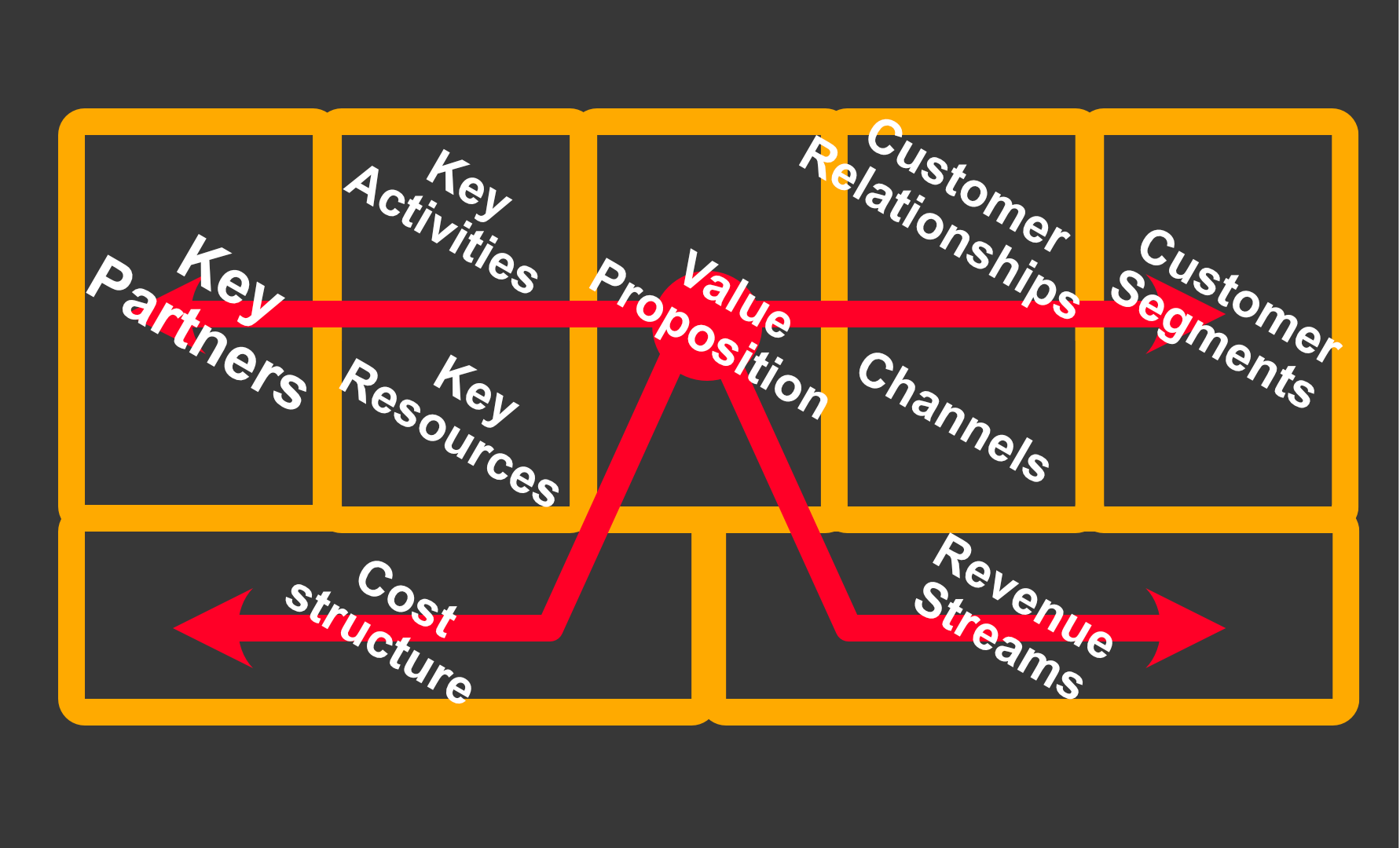
To merge this concept with the business model framework we will focus our efforts on the four actions framework. If you observe the Business model canvas you will see that it is divided into two halves, the left being the cost-side and the right being to value-side. You can think of the right side as what you do to provide value to customers and the left side what you do to create that value.

when it comes to the left hand side of the business model canvas, focus on 
  • Which factors that the industry takes for granted should be eliminated? 
  • Which factors should be reduced well below the industry's standard?
when it comes to the right hand side of the business model canvas focus on
  • Which factors should be raised well above the industry's standard? 
  • Which factors should be created that the industry has never offered?
by following the above approach you will successfully integrate both the blue ocean framework and the business model canvas, by visualizing all the building blocks of your business model it is easier to identify the operational blocks which can be eliminated or their cost reduced while at the same time looking to increase the value provided to customers. one thing to keep in mind is that we must focus our efforts where they will make the most impact, reducing the cost of something little will not impact the greater whole, look for high impact changes first.

Thursday, 11 May 2023

Business model design

"Business Model Generation" is a book by Alexander Osterwalder and Yves Pigneur which introduces the Business Model Canvas, a visual tool for creating and analysing business models.

The book is divided into five parts:

  1. Canvas: section introduces the Business Model Canvas and explains how to use it to design, test, and iterate on business models.
  2. Patterns:  section describes business models with similar characteristics, similar arrangements of business model building blocks or similar behaviours. Theses similarities are referred to as Business model patterns.
  3. Design: section delves into various design techniques which one can use to better create a value added business model
  4. Strategy: section deals with reinterpreting business strategy through the lens of the business model canvas, it helps constructively question established business practices while examining the environment in search of new opportunities.
  5. Processes: section proposes a generic business model design process, which is adaptable to to an organisations specific needs.

Overall, "Business Model Generation" is a practical guide for entrepreneurs, innovators, and business leaders who want to design and optimise their business models to create value for customers and achieve sustainable growth. 

Design

The design section of the book focuses is on the practical aspects of designing and implementing effective business models. It provides a number of techniques and tools to help design better and more innovative business models

Customer Insights

The Customer Insights section emphasizes the importance of understanding your target customer segments in order to create a business model that addresses their specific needs and preferences. The section provides guidance on how to gather and analyze customer insights, and how to use this information to refine your business model.

Some key steps in the Customer Insights section include:
  • Identifying your target customer segments: This involves defining the specific groups of customers that your business is targeting, based on factors such as demographics, behaviors, needs, and preferences.
  • Gathering customer data: This can be done through various methods, including surveys, focus groups, interviews, observation, and social media monitoring. The goal is to gather information about customer needs, pain points, preferences, and behaviors.
  • Analyzing customer data: Once you have gathered customer data, the next step is to analyze it to identify key insights and patterns. This can involve categorizing data, creating customer personas, and identifying common themes and trends.
Using customer insights to refine your business model: Based on your customer insights, you can make adjustments to your value proposition, channels, customer relationships, revenue streams, and other aspects of your business model to better meet the needs and preferences of your target customers.

Overall, the Customer Insights section of the "Design" chapter emphasizes the importance of gathering and analyzing customer insights in order to create a business model that is well-aligned with your target customer segments. By understanding your customers' needs and preferences, you can create a more compelling value proposition, more effective distribution channels, and more valuable customer relationships, ultimately leading to greater success and profitability for your business.

Talking about customer insights is one thing but actually mapping them is a different story 

A common technique to gain customer insights is an empathy map, which is a tool used in design thinking as well as OCM to help understand the needs, desires, and pain points of a particular user or customer group. It's a visual framework that helps teams gain a deeper understanding of their target audience's perspectives and experiences, which can then inform the development of more effective products, services, or communication strategies.

An empathy map typically consists of a simple diagram with four main quadrants and two sub suctions:


  • See: This quadrant captures what the user sees or observes. This includes their physical surroundings, the people they interact with, and any other contextual information that may be relevant.

  • Think and Feel: This quadrant captures what the user is thinking and feeling about their experiences. This includes their beliefs, attitudes, and emotions, as well as any biases or assumptions they may hold.

  • Say and Do: This quadrant captures what the user says and does in response to their experiences. This includes their verbal and nonverbal communication, as well as any actions they take in response to different situations.

  • Hear: This quadrant captures what the user hears from others, such as feedback, opinions, or advice.

  • Pain: what are the users biggest frustrations, what obstacles stand between them and what they want or need to achieve, and finally which risks might she fear taking?
By filling in each quadrant of the empathy map with relevant information, design teams can gain a more holistic view of their target audience, and identify opportunities to improve their experiences and meet their needs more effectively.

Ideation

Ideation is the process of generating and refining ideas for new business models. It provides guidance on how to use creativity and innovation to develop unique and compelling business models that can drive growth and profitability.

Some key elements of the Ideation section include:
  • Understanding the market and industry: This involves conducting research on market trends, customer needs, and industry dynamics to identify potential opportunities for innovation and disruption.
  • Brainstorming and ideation: This involves generating a large number of ideas for new business models, without judgment or evaluation. The goal is to encourage creativity and generate a wide range of possibilities.
  • Idea selection and evaluation: Once a large number of ideas have been generated, the next step is to evaluate them based on criteria such as feasibility, scalability, profitability, and alignment with the organization's mission and values.
  • Prototyping and testing: This involves creating a prototype or minimum viable product (MVP) to test and validate the business model in the market. This can involve testing assumptions, gathering feedback, and refining the model based on customer insights.

Overall, the Ideation emphasizes the importance of creativity, innovation, and experimentation in developing new business models. By generating a wide range of ideas, evaluating them systematically, and testing and refining the most promising ones, organizations can create business models that are well-aligned with market needs and trends, and that have the potential to drive growth and profitability over the long term.

The process of ideation can be viewed as a process of both divergent and convergent thinking.


Divergent thinking is the process of generating a wide range of ideas or possibilities. In ideation, this phase involves using various techniques such as brainstorming or mind-mapping to explore as many potential ideas as possible. The goal is to generate a high quantity of ideas without evaluating them or worrying about their feasibility. This approach encourages creativity, curiosity, and openness to new perspectives and possibilities.

Convergent thinking, on the other hand, is the process of evaluating and selecting the most promising ideas. In ideation, this phase involves reviewing and analyzing the ideas generated in the divergent thinking phase to assess their feasibility, impact, and value. This approach encourages critical thinking, analysis, and synthesis to arrive at a workable solution or idea.

The ideation process typically involves alternating between these two modes of thinking, starting with divergent thinking to generate a large quantity of ideas, and then moving to convergent thinking to evaluate, select, and refine the most promising ideas. This iterative process allows teams to continually build on and refine their ideas until they arrive at a viable and effective solution.

Overall, the divergent and convergent thinking approaches used in ideation complement each other to create a well-rounded and robust ideation process.

In the context of business model design, the divergent process encompasses many different techniques to help us create new models which challenge the status quo and suspend concerns of operational challenges, the main focus is to dream during the divergent phase.

when rethinking business models we can focus on four primary sources of innovation, and of course there is always the exception:


Resource driven: innovations originate from an organisation's existing infrastructure or partnerships to expand or transform the business model.


Offer-driven:
Innovations create new value propositions that affect other business model building blocks.


Customer-driven: innovations are based on customer needs, facilitated access or increased convenience. Like all innovations emerging from a single epicentre, they affect other business Model building blocks.


Finance-Driven: Innovations driven by new revenue streams, pricing mechanisms, or reduced cost structure that affect other business model building blocks.


Multi-Epicenter driven: Innovations driven by multiple epicenters can have significant impact on several other building blocks.

The Ideation process:

Leveraging design thinking to solve a problem is best described as structured chaos, it is important to start from a seemingly chaotic place, cast a wide net and then wrangle the chaos to something cohesive. Design thinking can be thought of as a controlled brainstorming session:
  • Team composition: Have a diverse team, different ages, genders, career levels, left and right brained people, the more opinions the better.
  • Immersion: live and breath the model, do the research, speak with customers, try the product or service, feel what works and what doesn't, understand the pain and pleaser points, empathize with the customer segments.
  • Diverge: iterate through each of the 9 business model building blocks, grow them, push them to their limits and beyond, go for quantity, do not limit yourself with feasibility. 
  • Converage: go through all of the ideas, the team came up with during the divergent phase and begin to focus to the most impactful and feasible ones (3 to 5), one caveat is to not discount crazy ideas, but instead refine them into feasible ones, use them as a starting point; try to redefine each solution to an actionable one before discounting it.
  • Prototype: After the converegent phase is complete aim to prototype the new business models.
During the design thinking process keep the following in mind:
  • Stay focused: Have a strongly defined problem statement around a specific customer need.
  • Prepare: Get the group into the right headspace, immerse the team in the problem, interview customers, go to the physical location, use the product or service, experience it from the perspective of the user.
  • Wild ideas welcome: Don't worry about feasibility, think crazy and wild, be divergent.
  • Quantity over Quality: During the divergent phase aim for as many ideas as possible as long as they meet the problem statement.
  • Defer judgement: During ideation do not discourage or discount any ideas, have an open mind.
  • Respect the speaker: One conversation at a time, one of the strongest ways to develop an idea is with the 'yes and' paradigm, for this to work, everyone must hear the idea.
  • Sell your idea: sketch the idea out, define the process with stickies, draw it out on a storyboard, act it out in a one (wo)man play, whatever it takes to convey your idea.
  • Think visually: Once your idea is understood define it as a sticky, don't lose it once the group understands, document it onto a board, move it around, combine it with other ideas, often times crazy ideas lead to solutions.

In short:
  1. Start by defining a problem statement
  2. Think of dozens of solutions, crazy, wild ideas,
  3. Converge on a 3 to 5 feasible solutions.
  4. Prioritise them, by some rubric that makes sense, then for each viable idea
    1. Design it
    2. prototype it
    3. test it
      • if the test fails, learn from your mistakes and prototype again.
      • if the test succeeds, validate it on a larger scale
Rinse and repeat till you are satisfied with a solution.